The Storms Rockwall Roofs Face, and Why Claim Timing Matters
Rockwall homeowners learn the local weather calendar the hard way, usually the first spring a storm takes out part of the roof. The county sits in a stretch of North Texas where the same conditions that make the land green in April also build the storms that bruise shingles and lift flashing. Understanding the storms Rockwall roofs face, and when the window to document damage opens and closes, is what separates a storm damage roof repair handled cleanly from one that turns into a fight with a carrier months later.
Why Rockwall Sits Where the Storms Form
The geography is not an accident. Rockwall County lies along the southern edge of the central United States severe weather corridor, the stretch of the Southern Plains where warm, humid air pushing up from the Gulf collides with cold air dropping down from the north. When the jet stream sets up over North Texas in spring, that collision builds the rotating thunderstorms, the supercells, that drop the largest hail. Rockwall's position on the eastern shore of Lake Ray Hubbard, with open water and open prairie to its west and north, gives those storms little to slow them before they arrive.
That is why the county's storm record reads the way it does. The National Weather Service office in Fort Worth and the NOAA Storm Events Database track the events, and Rockwall County's list is long: baseball-size hail on April 3, 2012, a 1.5-inch event on April 20, 2023, a 2-inch event on June 11, 2023, straight-line winds over the Dalton Ranch subdivision on March 29, 2017, an EF-1 tornado on October 20, 2019, the nearby Fate tornado on May 29, 2019, and a significant storm on May 28, 2024. These are not rare outliers. They are the pattern.
North Texas Sits at the Edge of Tornado Alley
Rockwall County lies along the southern reach of the central United States severe weather zone. Beyond hail, the county has recorded tornado activity, including an EF-1 tornado on October 20, 2019, and the May 29, 2019 Fate tornado nearby, alongside straight-line wind events capable of lifting shingles.
El Nino and La Nina Shift the Storm Odds
Climate patterns tracked by NOAA, including the El Nino-Southern Oscillation, influence how active a North Texas spring becomes. La Nina springs can shift the pattern of severe weather across the Southern Plains, which is why some years bring heavier hail seasons to Rockwall County than others.
The Peak Hail Months Are Narrow
While storms can strike across much of the year, the bulk of damaging hail in Rockwall County falls in a narrow spring window from April through June. That concentration is why so many roof claims in the area share a handful of storm dates each year.
Rockwall's roofing calendar has a clear peak. Spring storm season runs March through June, and the heaviest hail concentrates from April into June, when the atmospheric setup is most favorable for large stones. That narrow window is why so many roof claims across the county share a handful of dates each year. A single afternoon supercell can leave a trail of damaged roofs across North Rockwall, the subdivisions along Ralph Hall Parkway, and the lakefront homes on Lake Ray Hubbard, all tied to the same date of loss.
The season is not identical year to year. Climate patterns that NOAA tracks, including the El Nino-Southern Oscillation, shift the odds. A La Nina spring can change where and how often severe weather sets up across the Southern Plains, which is why some years bring a heavy hail season to Rockwall County and others pass more quietly. Those patterns are visible far enough ahead that a homeowner can treat a forecast active spring as a reason to get the roof looked at early.
The Case for a Pre-Season Inspection
A roof that is already documented before a storm arrives is a roof with an advantage when the claim goes in. A pre-season inspection, done before February in a year pointed toward an active spring, gives the homeowner a dated baseline of the roof's condition. If hail then hits in May, that baseline draws the line between new storm damage and the pre-existing wear a carrier would otherwise use to deny the claim. The whole wear-and-tear dispute that sinks so many hail claims gets easier to win when there is a record of the roof's condition the week before the storm.
A pre-season visit also catches the small problems that a storm turns into large ones, a lifted shingle, a cracked boot around a vent, a section of sealant that has let go. Resetting those before the storm season keeps a minor issue from becoming the entry point water uses when the weather turns. For lakefront and open-exposure homes along Lake Ray Hubbard that take the wind first, that early check is worth more than it costs, which is nothing when the inspection is free.
Why the Date of Loss Runs the Clock
Every storm claim hangs on a single date, the date of loss. Texas commonly gives a homeowner about a year from that date to file, and policies carry a duty to report the damage without unreasonable delay. Those two facts set the window. File inside it, with the damage tied to a storm date that shows up in NOAA records, and the claim stands on firm ground. Wait until the damage has aged, or until the homeowner cannot say which storm caused it, and the carrier gains every reason to call it wear and tear.
Timing cuts the other way too. A roof that took hail in May and does not get inspected until it leaks in October has lost months the sun spent working on the exposed mat, and it is months closer to the edge of the filing window. The storm damage that would have been a clean, dated claim in spring becomes a harder case in fall. The lesson Rockwall homeowners take from a few seasons here is simple: inspect after the storm, not after the leak.
Reading the Roof Against the Record
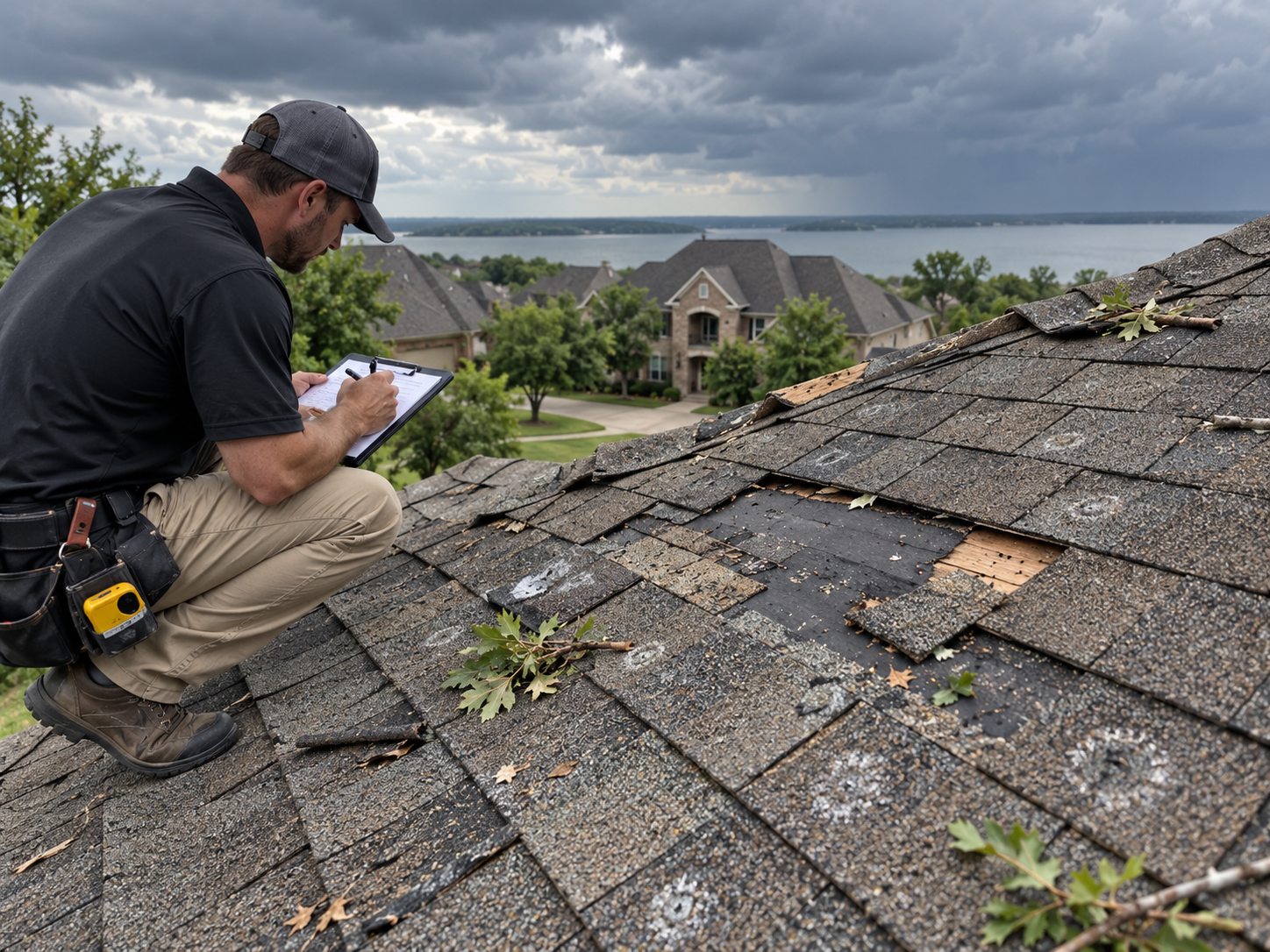
Matching a roof's damage to the storm record is part of how SCR documents a Rockwall claim. When the bruising pattern, the hail size read from the marks, and the direction of impact line up with a confirmed event on a known date, the claim gains a backbone the carrier cannot easily argue with. SCR, founded in 1998 and led by a former catastrophic adjuster, builds the damage report around that match, so the homeowner is handing the carrier a documented event, not a guess about when the damage happened.
This is also why not every roof with old granule loss has a claim. An honest inspection separates damage that ties to a covered storm from wear that does not, and says so. A homeowner is better served by a clear answer than by a filing that gets denied and leaves a claim on the record for nothing.
Living With the Rockwall Storm Calendar
There is no changing where Rockwall sits or what rolls across it each spring. What a homeowner can change is whether the roof is ready and whether the claim is timed right. A pre-season inspection in late winter, a quick inspection after any notable hail or wind, and a claim filed while the storm is recent and verifiable put a homeowner in the strongest position the county's weather allows. The alternative, waiting until water shows on a ceiling, hands the advantage to time and to the carrier.
How ENSO Shapes a North Texas Spring
The pattern that decides how rough a Rockwall spring gets forms far from Texas, in the Pacific Ocean. The El Nino-Southern Oscillation, which NOAA tracks through its warm El Nino phase, its cool La Nina phase, and a neutral middle, shifts the jet stream that steers storms across the United States. A La Nina spring tends to change where the strongest severe weather sets up across the Southern Plains, and some La Nina years have lined that activity up over North Texas. These patterns are forecast months ahead, which gives a homeowner a usable signal: a spring pointed toward an active severe season is a spring to get the roof inspected before, not after.
None of this makes a specific storm predictable, and no one can say a given roof will take hail on a given date. What the pattern does offer is odds. In a year the Climate Prediction Center flags for an active Southern Plains spring, the base rate of a damaging hail event over Rockwall County climbs, and a homeowner who treats that as a reason for a late-winter inspection is playing the odds sensibly rather than waiting to be surprised.
Protecting the Roof Between Storms
The work that keeps a roof storm-ready happens in the quiet months, not during the storm. Keeping gutters clear so water drains instead of backing up under the shingle edge, trimming the mature tree limbs that overhang the roof in older Rockwall neighborhoods, checking that flashing and vent seals are intact, and resetting any shingle that has lifted all reduce the entry points a storm exploits. None of it stops hail, but it removes the small weaknesses that turn an average storm into a leak. A roof in good condition going into April takes a storm far better than one already carrying minor damage.
This maintenance also feeds the claim side. A roof that is documented and sound before the season gives a homeowner a baseline that separates new storm damage from old wear, which is the exact line a carrier uses to deny. The pre-season inspection and the between-storm upkeep are two parts of the same strategy: go into the season with a roof that is both ready for the weather and documented against the claim.
What to Keep on File for a Claim
When a storm does hit, the homeowner who settles a claim cleanly is usually the one who kept records. A dated pre-season inspection report, photos of the roof in good condition, receipts for any prior repairs, and a note of the storm dates the National Weather Service confirmed for the area all build a file that answers a carrier's questions before they are asked. The date of loss, pinned to a verified event, is the anchor, and date-stamped photos taken right after the storm are the proof. A homeowner with that file is not reconstructing events months later; they are handing over a record.
SCR builds much of that file for the homeowner through its inspections, but the habit of keeping the paperwork is the homeowner's to hold. A roof is a long-term asset in a county that tests it hard every spring, and the documentation is part of protecting that asset through the claims the weather will eventually bring.
Why Local Timing Knowledge Matters
A contractor who has worked Rockwall County since 1998 has watched the storm calendar repeat for more than two decades, and that track record informs the timing advice it gives. SCR knows which months bring the hail, how a La Nina spring has played out here before, and how fast the Texas sun ages an exposed mat once a storm passes. That local read is the difference between generic advice to inspect sometime and a specific recommendation to get the roof looked at before February in a year the pattern is pointing the wrong way.
The homeowners who come through Rockwall storm seasons with the least stress are the ones who treat the roof as a managed asset rather than a thing they think about only after it leaks. A late-winter inspection in an active year, clear gutters and trimmed limbs going into spring, and a claim filed quickly against a verified storm date together turn the county weather from a yearly crisis into a routine the homeowner controls.
Rockwall has grown quickly along State Highway 205 and Ralph Hall Parkway, and much of that newer housing sits on open lots that take wind and hail with little shelter. For those homeowners especially, the storm calendar is not an abstraction. A roof on an exposed lot in a subdivision like Dalton Ranch sees the weather first, which is exactly why a late-winter inspection and a quick post-storm check pay off more there than almost anywhere else in the county.
Homeowners across Rockwall County can book a free pre-season or post-storm inspection with SCR, Inc. General Contractors and get a dated, written record of the roof's condition to anchor any claim the season brings. To schedule a storm damage inspection or learn more, call (972) 839-6834 or visit scr247.com/storm-damage-roof-repair-rockwall-tx.
The association of Paleo-Indianartifacts with extinct Pleistocenemammal remains in various archeological sites within the Texas Prairie-Savannah Region of eastern North Central Texas, including a site in Collin County, and Clovis points recovered from the Brushy Creek Clovis Site in Hunt County demonstrates that the Rockwall region was occupied by prehistoric Native American cultures at least as far back as 13,500 to 13,000 years ago.[7][8][9] More recently, the Rockwall region was occupied by Caddo Indians. Creek Indians moved to the area in the early 19th century. In 1925, Byron Khun de Prorok claimed that the wall was built by a prehistoric race, though this has been widely dismissed .[10][11][12][13]
In 1851, the first Anglo-American settlers moved to the area, and wells were dug. During the digging, they found large underground rock walls that were initially believed to be man-made. Later study of the wall-like features by geologists and archaeologists found them to be jointed, natural sandstone dikes that had intruded Cretaceousmarl.[11][12] The wall, when viewed from above, runs in long straight lines with angles that form a near perfect rectangle. The eastern wall has several deviations that run in straight lines with sharp angles, which would be unusual for a natural formation in an already unusual closed loop wall formation.
The town was established April 17, 1854 and named after these natural rock walls. While originally part of Kaufman County, in 1873, Rockwall County was formed with Rockwall being the county seat.[14]
According to the United States Census Bureau, the city has a total area of 31.6 square miles (82 km2), of which 22.3 square miles (58 km2) is land and 0.4 square miles (1.0 km2) (1.63%) is water.
The climate in this area is characterized by hot, humid summers and generally mild to cool winters. According to the Köppen Climate Classification system, Rockwall has a humid subtropical climate, abbreviated "Cfa" on climate maps.[16]
As of the 2020 census, there were 47,251 people, 16,798 households, and 12,771 families residing in the city. The median age was 39.3 years, with 25.8% of residents under the age of 18 and 15.2% 65 years of age or older. For every 100 females there were 95.0 males, and for every 100 females age 18 and over there were 91.7 males age 18 and over.[19]
97.9% of residents lived in urban areas, while 2.1% lived in rural areas.[20]
There were 16,798 households in Rockwall, of which 38.6% had children under the age of 18 living in them. Of all households, 60.8% were married-couple households, 12.1% were households with a male householder and no spouse or partner present, and 23.0% were households with a female householder and no spouse or partner present. About 20.9% of all households were made up of individuals and 10.2% had someone living alone who was 65 years of age or older.[19]
There were 17,772 housing units, of which 5.5% were vacant. The homeowner vacancy rate was 2.3% and the rental vacancy rate was 8.1%.[19]
According to the city's 2009 Comprehensive Annual Financial Report Fund Financial Statements, the city's various funds had $39.0 million in revenues, $42.2 million in expenditures, $32.3 million in total assets, $3.6 million in total liabilities, and $25.9 million in investments.[22]
The structure of the management and coordination of city services is:[23]
Department
Director
City Manager
Mary Smith
Assistant City Manager
Joey Boyd
Director of Public Works/City Engineer
Amy Williams, PE
Director of Parks and Recreation
Travis Sales, MCPTM
Chief of Police
Ed Fowler
Fire Chief
Kenneth Cullins
Director of Planning
Ryan Miller, AICP
The city of Rockwall is a voluntary member of the North Central Texas Council of Governments association, the purpose of which is to coordinate individual and collective local governments and facilitate regional solutions, eliminate unnecessary duplication, and enable joint decisions.
The city is home to the Higher Education Center at Rockwall, which is part of the community college district, Collin College. The campus is the District's first campus outside of Collin County itself. Texas A&M University-Commerce holds classes at the center.
Rockwall offers many different sports complexes as well as activities. Airport Road boasts baseball fields, as well as the Landing Point complex containing the Texas International Fencing Center, zipline and dance facilities. The Rockwall Indoor Sports Expo is located on South 205. Lake Ray Hubbard has several boating marinas and is used for jet skiing.
Rockwall also offers 2 different Golf Courses [27] within 17 miles of the center of Rockwall.
^Crook, W.W. III, M.D. Hughston and J.L. McCraw, 2009, The Brushy Creek Clovis Site (41HU74): An Early Paleoindian Occupation in Hunt County, Texas. The Record, Dallas Archeological Society 56(1):1-18.
^Crook, W. W., III, 2011, A Possible Association of Worked Flakes with Probosidian Bones near Lake Lavon, Collin County, Texas. Archeological Journal of the Texas Prairie-Savannah 1(1):4-8.
^Ferring, C.R., 2000, The Archeology and Paleoecology of the Aubrey Clovis Site (41DN79) Denton County, Texas. Center for Environmental Archeology, Department of Geography, University of North Texas, Denton.
^ abMonroe, J.N., 1950, Origin of the clastic dikes in the Rockwall area, Texas. Field and Laboratory. v. 18, no. 4, pp. 133-143.
^ abEllwood, B.B., J. Payne, and G.J. Long, 1989, The Rockwall, Texas: A study of unusual natural magnetic effects in geoarcheological surveys produced by mineral oxidation.[link removed] Geoarchaeology. v. 4, no. 2, pp. 103-118.
Many Texas policies allow about one year to file a hail claim, though terms vary, so timely documentation matters. Hail damage that is not claimed in time becomes the homeowner's problem when it finally causes a leak. SCR, with former insurance adjusters on staff, documents storm damage quickly to support a Wills Point homeowner's claim.
Should I get my roof inspected before storm season?
A local roofing contractor with a permanent presence is the safer choice. Out-of-state storm chasers follow hail events, do quick work, and leave, often with no one to honor a warranty. SCR has served North Texas since 1998 with local offices, so it is there before the storm and long after to stand behind the work.
How soon after a storm should I file a roof claim?
File while the event is recent and verifiable. Texas commonly allows about a year from the date of loss, but carriers expect reporting without delay, and a fresh, well-documented claim tied to a confirmed storm date in NOAA records faces fewer disputes than one filed long after the fact.