What Sets a Reliable Insulation Company Apart in Los Angeles
Hiring the wrong insulation company costs more than money. It can mean paying for a top-up that should have been a removal, insulation installed below the depth the code requires, or a rodent problem buried instead of solved. In a market the size of Los Angeles, the range of insulation companies runs from careful, licensed contractors to operators who quote low, work fast, and leave the real problems in place. For a homeowner, the challenge is telling them apart before signing, not after. A few clear standards separate a reliable insulation company from a risky one, and they are easy to check once a homeowner knows what to look for.
This matters across the San Fernando Valley and Greater Los Angeles because the housing stock makes insulation work common and the stakes specific. Homes from the 1950s through the 1980s in Northridge, Reseda, Van Nuys, and Canoga Park often need removal, air sealing, and replacement rather than a simple add-on, and the local climate code sets real requirements. An insulation company that understands those conditions produces a very different result from one that treats every attic the same. The markers below are what a homeowner can use to judge insulation companies in Los Angeles on substance rather than on advertising.
License, Insurance, and a Record You Can Check
The first marker is a verifiable license. In California, insulation work of any real size should be done by a licensed contractor, and the California Contractors State License Board lets anyone confirm a license number online, including whether it is active and in good standing and whether it carries complaints. A reliable insulation company provides its license number without hesitation. An operator who dodges the question, or works without a license, is a risk no price justifies. Insurance belongs in the same category. Proper liability and workers compensation coverage protects the homeowner if something goes wrong on the job.
Local track record rounds out the picture. An insulation company with years of work across Los Angeles has seen the range of attics the area produces, from mid-century ranch homes with contaminated insulation to newer construction that only needs air sealing. Longevity is not proof of quality on its own, but combined with a verifiable license and real reviews it signals a company that has to stand behind its work. Pure Eco Inc., for example, operates under California contractor license number 993589 with more than 20 years in the local insulation market, the kind of checkable record a homeowner can confirm rather than take on faith.
Knowledge of the Local Code and Climate
The second marker is genuine familiarity with California Title 24 and the local climate zones. Title 24 Part 6 sets home energy requirements by zone, and most of the Los Angeles basin and the San Fernando Valley fall in Climate Zone 9, where attic retrofits commonly target R-30 to R-38, with R-49 used for higher performance. An insulation company that works in Los Angeles should be able to explain the target depth for a home and document the work for permit and rebate purposes. One that cannot discuss R-values or Title 24 in plain terms is not equipped to bring an attic up to standard.
Climate knowledge goes beyond the code. San Fernando Valley attics reach 130 to 150 degrees on south- and west-facing roofs at peak summer, which drives air conditioning run time and makes radiant barriers and air sealing worthwhile in a way they are not in milder climates. An insulation company that understands the local heat load recommends the right combination for a home rather than a one-size product. That judgment, matched to the actual house and its exposure, is what a homeowner is really paying for.
A Real Inspection and an Honest Scope
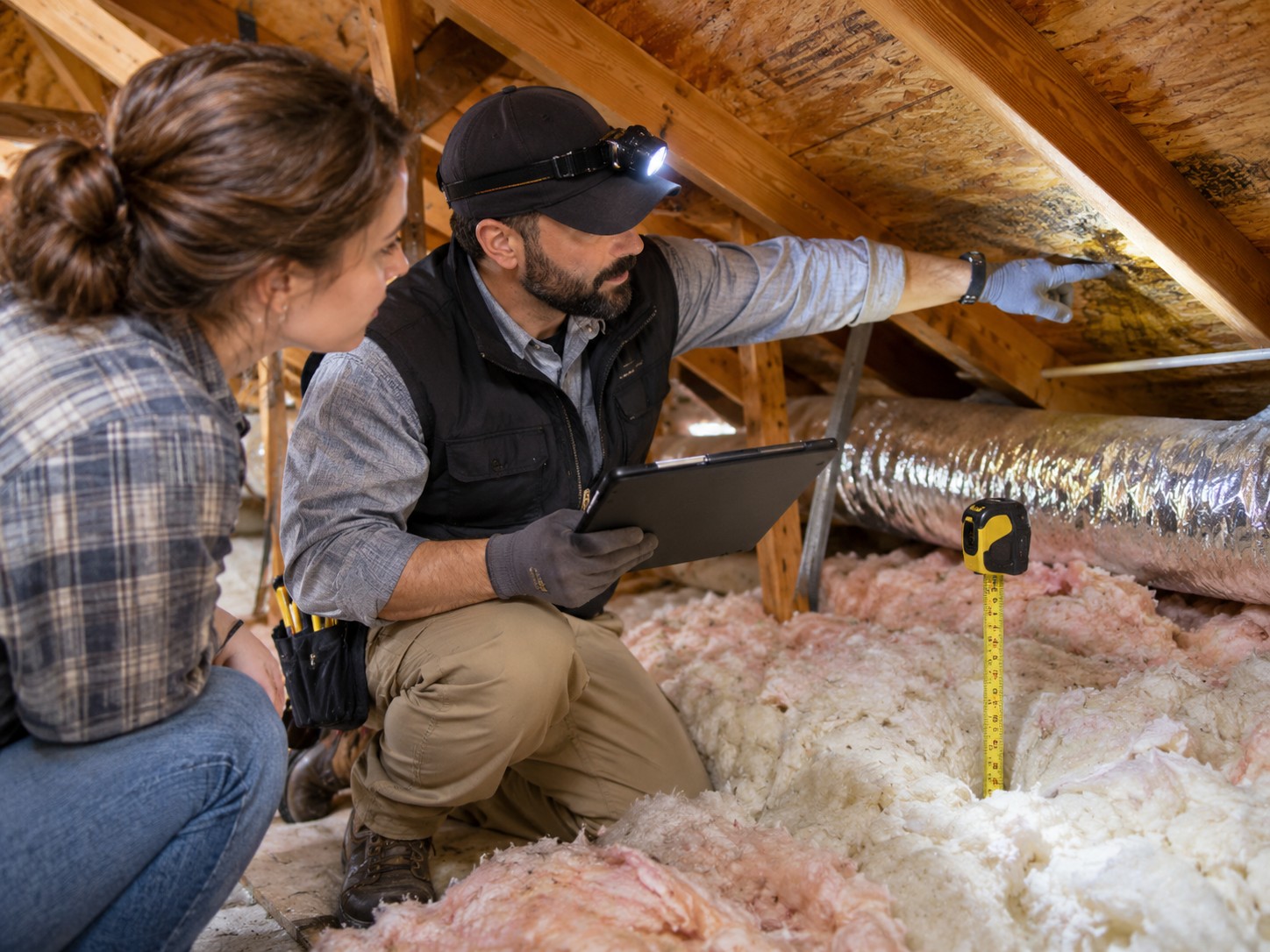
The third marker is how the company arrives at its recommendation. A reliable insulation company inspects the attic before quoting, because the right scope depends on what is up there. It should be able to tell a homeowner whether the existing insulation can be topped up or has to be removed, whether rodents or moisture are present, whether a pre-1980 home needs asbestos or vermiculite testing before any work begins, and whether air sealing should happen before new insulation goes in. A quote offered without an inspection, or a recommendation to simply add insulation without checking what is underneath, is a warning sign.
A license number you can verify through the California Contractors State License Board
Proof of liability and workers compensation insurance
Clear answers on Title 24, climate zone, and target R-value for your home
An attic inspection before any quote, not a price over the phone
A written, itemized estimate, which California law requires over 500 dollars
Honesty shows up in what a company declines to sell. A contractor who tells a homeowner that a clean, dry attic only needs a modest top-up, rather than pushing a full tear-out, is demonstrating the judgment worth hiring. The same goes for one who flags a pre-1980 home for testing instead of rushing in. These moments, where a company could upsell but does not, are often the clearest signal of which insulation companies in Los Angeles can be trusted with a home.
Straight Talk on Cost, Rebates, and Warranties
The fourth marker is transparency about money. A reliable insulation company gives an itemized written estimate that shows what each part of the job costs, from removal and disposal to air sealing and new material. It is straight about rebates, pointing homeowners to current LADWP and SoCalGas programs for qualifying upgrades while being clear that amounts and eligibility change and should be confirmed with the utility. It does not promise a federal tax credit that no longer applies, since the federal residential energy credits under Sections 25C and 25D ended for property placed in service after December 31, 2025. And it stands behind the work with clear warranties on both materials and labor.
Energy savings claims are another honesty test. Bringing an under-insulated attic up to standard can reduce home energy use by as much as 20 percent, a figure consistent with what building scientists cite, but the real result depends on the home and should be presented as a ceiling rather than a guarantee. An insulation company that promises a specific large percentage for every house, or quotes a rebate as certain, is overselling. One that frames savings as a realistic range and ties them to the specific attic is giving a homeowner the truth they can plan around.
Put together, these markers turn a confusing choice into a checkable one. A verifiable license and insurance, real knowledge of Title 24 and the local climate, an inspection-based scope, honest talk about cost and rebates, and clear warranties are the standards that separate a reliable insulation company from a risky one. A homeowner who holds every quote to them will spend less time worrying about being misled and more time getting an attic that actually performs, whichever company earns the job.
Questions Worth Asking Before You Sign
A short set of questions tells a homeowner most of what they need to know about an insulation company. Asking how the attic was assessed reveals whether the quote rests on a real inspection or a guess. Asking what R-value the company recommends and why shows whether it understands Title 24 and the home's climate zone. Asking how removal, air sealing, and new material are each priced exposes whether the estimate is itemized or a vague lump sum. And asking what warranty covers both the material and the labor shows whether the company expects to stand behind the work. Clear answers to these point to a company worth hiring.
Just as telling is how a company handles the questions it cannot answer neatly. A contractor who admits that a rebate amount depends on the current utility program, or that savings depend on the specific home, is being honest about things outside its control. One that promises a guaranteed rebate figure or a fixed large percentage of savings for every house is overselling. In a market with as many insulation companies as Los Angeles, that candor is one of the more reliable ways to separate the contractors worth trusting from the ones to avoid.
Reviews, References, and Local Reputation
Online reviews are a starting point, not a verdict. A long record of consistent feedback across several platforms says more than a handful of glowing entries posted in a single week. More useful still are references a homeowner can actually speak to, especially for larger projects, because a past customer can describe how the company handled surprises, kept the site clean, and followed through on the warranty. A reputable contractor offers references without hesitation. Reluctance to provide them is its own answer.
Local reputation carries particular weight in this trade. A company that has worked across the San Fernando Valley and Greater Los Angeles for years has dealt with the specific attics the area produces and has a name to protect in the communities it serves. That local accountability tends to produce more careful work than a crew passing through, because word travels among neighbors and the company has to live with its results. Pairing that local track record with a verifiable license and real references gives a homeowner a grounded read on who they are hiring.
Warranties That Mean Something
A warranty is only as good as its terms, so a homeowner should look past the word and read what it actually covers. Insulation work typically carries two kinds: the manufacturer's warranty on the material itself and the contractor's warranty on the installation labor. The questions that matter are how long each lasts, what they include and exclude, and whether the company will still be around to honor them. A written warranty tied to a licensed, established insulation company is worth far more than a verbal assurance from an operator who may not answer the phone next year.
Rodent proofing and attic cleaning often come with their own warranty terms, and those deserve the same scrutiny. A homeowner paying to seal entry points should know how long the exclusion is guaranteed and what happens if pests return within that window. Clear, written warranty terms are a sign that a company has thought about the long-term result rather than only the sale, which is exactly the mindset a homeowner wants in whoever works on the attic.
Putting the Markers Together
No single factor settles the choice, but together the markers form a reliable picture. A verifiable license and insurance establish that the company is legitimate and accountable. Real knowledge of Title 24 and the local climate shows it can bring an attic up to standard. An inspection-based scope and an itemized written estimate show it is quoting the real job. Honest talk about rebates, savings, and the ended federal tax credit shows it will not mislead. And meaningful warranties show it intends to stand behind the result. A homeowner who holds every bid to this standard turns a confusing market into a manageable decision.
A final habit protects a homeowner regardless of which contractor earns the job: keep every promise in writing. A verbal assurance about R-value, rebates, disposal, or warranty terms is hard to hold anyone to later, while a written scope and contract give both sides a clear record. California law already requires a written contract for home improvement work over 500 dollars, so insisting on one is simply using the protection the state provides.
Pure Eco Inc. provides whole-home insulation services across the San Fernando Valley and Greater Los Angeles from its Chatsworth headquarters at 9740 Variel Ave, under California contractor license number 993589 with more than 20 years of local experience, free home assessments, and written estimates. Homeowners comparing insulation companies in Los Angeles can reach the team at (877) 870-7998 or learn more at https://www.pureecoinc.com/.
Licenses are public and quick to check
The California Contractors State License Board publishes license status online, so any homeowner can confirm that an insulation company's license number is active, in good standing, and free of unresolved complaints before signing. A contractor who hesitates to share a license number is a risk that no low quote offsets.
Most of LA sits in Title 24 Climate Zone 9
California Title 24 Part 6 sets home energy requirements by climate zone, and the bulk of the Los Angeles basin and the San Fernando Valley fall in Zone 9. Attic retrofits there commonly target R-30 to R-38, so an insulation company working locally should be able to explain target depth in plain terms.
The federal insulation tax credit has ended
The federal residential energy efficiency tax credits under Sections 25C and 25D ended for property placed in service after December 31, 2025. A 2026 insulation project should not be budgeted around them, though local LADWP and SoCalGas rebates may still apply for qualifying upgrades and should be confirmed with the utility.
Chatsworth is a suburban neighborhood in Los Angeles, California, in the San Fernando Valley. The area around the town was home to Native Americans, who left caves containing rock art. Chatsworth was discovered and settled by the Spanish beginning in the 18th century. The land was part of a Spanish land grant, Rancho Ex-Mission San Fernando. After the United States purchased the land following the Mexican–American War, it was the largest such grant in California. Chatsworth has seven public and eight private schools. There are large open-space and smaller recreational parks as well as a public library and a transportation center. Landmarks in the town include the former Chatsworth Reservoir and the Santa Susana Field Laboratory. The neighborhood has one of the lowest population densities in Los Angeles and a relatively high income level. Chatsworth is the home of the Iverson Movie Ranch, a 500-acre (202-hectare) area which was the most filmed movie ranch in history, as more than 2,000 productions used it as a filming location.
This section needs to be updated. Please help update this article to reflect recent events or newly available information.(January 2025)
The 2000 U.S. census counted 35,073 residents in the 15.2 square miles (39 km2) Chatsworth neighborhood, or 2,301 people per square mile, among the lowest population densities for both the city and the county. In 2008, the city estimated that the population had increased to 37,102. In 2000, the median age for residents was 40, considered old for city and county neighborhoods; the percentages of residents aged 35 and older were among the county's highest.[2]
The neighborhood was considered to be ethnically "moderately diverse" for both the city of Los Angeles and its county, with a relatively high percentage of whites and Asian people, and a sizable Hispanic/Latino community. The population was 65.7% Non-Hispanic White, 14.4% Asian, 13.5% Hispanic or Latin, 2.2% Black, and 4.2% of other origins. Among the 25.2% of residents born abroad - a low figure for Los Angeles - Korea (10.4%) and the Philippines (9.3%) were the most common places of birth.[2]
The median yearly household income in 2008 dollars was $84,456, considered to be a high income for the city. The percentages of families that earned more than $40,000 was considered high for the county. Renters occupied 28.9% of the housing stock, and house- or apartment-owners held 71.1%. The average household size of 2.6 people was considered average for Los Angeles.[2]
In 2000, there were 2,933 military veterans, or 10.8% of the population, a high percentage compared to the rest of the city. The percentage of married people was among the county's highest. The rate of 10% of families headed by single parents was low for the city.[2]
Chatsworth is flanked by the Santa Susana Mountains on the north, Porter Ranch and Northridge on the east, Winnetka, Canoga Park, West Hills on the south, the Simi Hills, and unincorporated Los Angeles County and Ventura County on the west, and Twin Lakes, a community founded by San Francisco's George Haight in the early 20th century and unincorporated Los Angeles County which includes a 1,600-acre park with equestrian trails, to the north.[3][4]
Chatsworth was inhabited by the Tongva, Chumash, and Tataviam. They inhabited the valley for an estimated 8,000 years. Stoney Point is the site of the Tongva village of Momonga, which was also a trading place with the neighboring Tataviam and Chumash people.[6] The nearby Burro Flats Painted Cave remains a legacy of the Chumash culture's rock art and solstice ceremony spirituality.[7]
The first European explorers came into the Chatsworth area on August 5, 1769, led by the Spanish military leader Gaspar de Portolà. With its establishment in 1797 and subsequent Spanish Land Grant by the King of Spain, Mission San Fernando (Mission San Fernando Rey de España) gained dominion over the San Fernando Valley's lands, including future Chatsworth.
The Native American trail that had existed from the Tongva-Tatavium village called rancheria Santa Susana (Chatsworth) to another village, replaced by Mission San Fernando, became the route for missionaries and other Spanish travel up and down California. It was part of the El Camino del Santa Susana y Simi trail that connected the Valley's Mission, Los Angeles pueblo (town), and the southern missions with the Mission San Buenaventura, the Presidio of Monterey, and the northward missions. The trail crossed over the Santa Susana Pass to the Simi Valley, through present day city park Chatsworth Park South and the Santa Susana Pass State Historic Park. In 1795, the Spanish land grant had been issued for Rancho Simi, reconfirmed in 1842 by the Mexican governor.[8][9][10] Its lands included part of current Chatsworth, westward from Andora Avenue.
The Chatsworth Historical Society was formed in 1963 in an effort to successfully save the historic Pioneer Church from demolition. The society and Chatsworth Museum are located in Chatsworth Park South at Los Angeles Cultural Historical Monument No. 133, the Homestead Acre . In addition to preserving Chatsworth history and educating the public, the society acts as conservator of the Homestead Acre.[12]
The center of Chatsworth, 1911, on what is now Topanga Canyon Boulevard
In 1869, the grantee's son, Eulogio F. de Celis, returned from Spain to Los Angeles.[13] In 1874, the family sold their northern half of Rancho Ex-Mission San Fernando to northern Californians, California State SenatorCharles Maclay and his partners George K. Porter, a San Francisco shoe manufacturer, and his cousin Benjamin F. Porter. The Porters' land was west of present-day Sepulveda Boulevard including most of Chatsworth, and the Maclay land was east of Sepulveda Boulevard.[14]
The Old Santa Susana Stage Road or Santa Susana Wagon Road continued in use as an alternative to the route along El Camino Viejo from 1861 to 1875, replacing the older road as the main route between Los Angeles and San Francisco. The downgrade from the Santa Susana Pass into Chatsworth was known as "The Devil's Slide". A new wagon route bypassing the deteriorating Devil's Slide was opened in 1895. Initially called El Camino Nuevo (the New Road), it was later named the Chatsworth Grade Road, which continued in use until Santa Susana Pass Road (now Old Santa Susana Pass Road) was built in 1917. In 1876, the Southern Pacific Railroad opened a tunnel through the Newhall Pass, enabling rail connections from Los Angeles north to San Francisco, and rail travel soon replaced travel by stagecoach between Los Angeles and San Francisco. From this time, the stagecoach traffic to Santa Barbara once again used the coast route, and the Santa Susana Pass road was relegated to local traffic.[15] Construction of the 118 Ronald Reagan Freeway through the Santa Susana Pass began in 1968 with major traffic now bypassing Santa Susana Pass Road.[16]
The Chatsworth name, which hails from the stately Chatsworth House in Derbyshire, England, was first recorded in 1888, when George R. Crow filed with the Los Angeles County Recorder's Office a map of the San Fernando Valley with a subdivision he called "Chatsworth Park". William Booth Barber, the president of the San Fernando Valley Improvement Company, was born in England 17 miles from the Duke of Devonshire's palatial estate, Chatsworth House. In 1893 W.B. Barber filed an additional map with the Recorder's Office called the "Plat of Chatsworth Park Townsite".[17]
The Chatsworth Transportation Center also offers connections to several Los Angeles Metro, Simi Valley, and Santa Clarita bus routes. It is located at 10046 Old Depot Plaza Road, between Devonshire and Lassen streets.[28]
Chatsworth is serviced by the 118 freeway in the northern end of the neighborhood.
Chatsworth Park North: includes more than 20 acres (81,000 m2) of the scenic Simi Hills and is operated by the Los Angeles Parks Department,[31][32] has three baseball diamonds, football field, and outdoor basketball courts, all lighted; volleyball courts, a children's play area, hiking trails, a jogging path, and picnic tables with barbecue pits.[33] The park now has fencing that blocks visitors from climbing the large boulder outcrops, but Stoney Point Park and Chatsworth Park South are nearby for bouldering and rockclimbing
Chatsworth Park South: includes more than 100 acres (0.40 km2) of the rocky landmark Simi Hills.[34] Chatsworth Park South is adjacent to the Santa Susana Pass State Historic Park, a 174-acre (0.70 km2) National Register of Historic Places property consisting of historic features and deposits, prehistoric village site remnants, and portions of the Old Santa Susana Stage Road, which was the main route for mail and travelers between Los Angeles and San Francisco from 1861 until the opening of rail connections between the two cities in 1876. The stage route was also declared Los Angeles Historic-Cultural Monument #92 (designated January 5, 1972) and Ventura County Historical Landmark #104 (designated October 21, 1986).[35] The park has miles of horseback, jogging, and hiking trails, picnic tables and barbecue pits, and bouldering outcrops[36]
Chatsworth Recreation Center facilities are located within the lower area of Chatsworth Park South, with lighted indoor basketball courts, lighted outdoor basketball courts, a children's play area, an indoor gymnasium, a stage, and lighted tennis courts[37]
The Minnie Hill Palmer House, one of the West Valley's historic original homestead houses, is in Chatsworth Park South for visits and the Chatsworth Historical Society archives
The park had been closed from February 2008 to 2018 due to contamination discovered from when the park used to be a shooting range for Roy Rogers[38]
Michael D. Antonovich Park at the Joughin Ranch: includes over 1600 acres of hiking, equestrian trails, creeks, waterfalls and the site of one of the historic Bannon Quarries[39]
Santa Susana Pass State Historic Park (SSPSHP): a large natural area adjacent to and above the town's western side.[40] The Santa Susana Pass State Historic Park protects and offers a historical site of the late 19th century, when Chatsworth was on a main thoroughfare for the figures of the American West. Joaquin Murrieta and his bandits hid out in the rocky crevices around Stoney Point. The Old Stagecoach Trail above Chatsworth to the west, is now a popular hiking trail in the Simi Hills. It goes through Santa Susana Pass State Historic Park and Chatsworth Park South and by Chatsworth Oaks Park. The State Park is open to the public with several parking and trailhead areas and many hiking and view opportunities[41]
Chatsworth Oaks Park: an approximately 3-acre (1.2 ha) natural open space park. It has barbecue pits, a children's play area, and picnic tables near the parking area. Visitors may ride bicycles and hike in the park, which has no established trails but links to nearby Santa Susana Pass State Historic Park. The park overlooks the Chatsworth Nature Preserve, with birdwatching opportunities[42]
Stoney Point Park: at Stoney Point is a natural rock outcropping, geographic promontory landmark and legendary bouldering and rock climbing location on 76-acre (31 ha). The boulders at Stoney Point Park merge and form alcoves, caves, and dens. The park also has bridle paths, hiking trails, and connections to adjacent parks to the north.[43] Stoney Point is thought to be the site of the Tongva settlement named Asha'awanga or Momonga. Browns Creek Bike Path ends near Stoney Point
Chatsworth Trails Park: in the Santa Susana Mountains foothills just north of the 118 Freeway with parking at 11200 Mayan Drive. Chatsworth Trails Park has miles of horseback, hiking, and mountain biking trails and is also a hub connecting to the huge Michael D. Antonovich Regional Park at Joughin Ranch, the Indian Springs Open Space Park, and Rocky Peak Park at Rocky Peak.[44] The Rim of the Valley Trail passes through here, with trailhead access[45]
Sage Ranch Park: overlooks Chatsworth from its 2,000-foot (610 m) high ridges in the Simi Hills near the Santa Susana Field Laboratory. It is a new open space park at the end of Woolsey Canyon Road. Sage Ranch Park has campsites, walking and hiking trails, and panoramic views of the San Fernando and Simi Valleys.[46] It is located in Simi Valley
Mason Park:[47] offers barbecue pits, lighted and unlighted baseball diamond, children's play area, and picnic tables[47]
Mason Recreation Center:[48] has an indoor gymnasium that may also be used as a 400-capacity auditorium
Mason Child Care Center:[49] is licensed to have from up to 30 children of ages three and up to 60 school age children in educational and recreational activities at the center
A distinctive feature in Chatsworth is the Chatsworth Dam and reservoir. Built in 1918 as part of the Los Angeles Aqueduct system, the property belongs to the Los Angeles Department of Water and Power. Due to increasing concerns of the water quality because of algae plumes and storm water inflow, it was taken out of service in August 1969. After the 1971 San Fernando earthquake additional concerns for seismic safety led to its abandonment by the LADWP as a storage facility.[50] Chatsworth Oaks Park and the Chatsworth Nature Preserve are located here giving views of migrating birds and other animals, and their sounds such as the coyotes calling in the evening. The views of the rocky and dramatic Simi Hills surround the open space.[51]
Chatsworth Reservoir is classified by the Los Angeles Times as a city neighborhood, but "because there are relatively few homes in this area," the Times does not provide separate statistics for it, but adds them to Chatsworth.[52] The Devonshire and Topanga stations of the Los Angeles Police Department provide services in the area.[53]
Chatsworth is the home of the National Notary Association and the headquarters for Premier America (formerly Litton Federal Credit Union) and Matadors Community Credit Union.
The Santa Susana Field Laboratory (SSFL), once busy with Rocketdyne testing rocket engines and Atomics International doing nuclear research, is high in the Simi Hills west of Chatsworth.[54] It has been closed and will undergo an extensive environmental cleanup, andsoon become an open-space park.[55] The park will permanently add to Chatsworth's scenic backdrop, greenway, and hiking opportunities.[56]
Titus Software's United States subsidiary once had its headquarters in Chatsworth.[57]
Seltzer Motor Industries, of Chatsworth, in 1979 produced the Willow, a two-seat sports car kit. It is the first transverse, inline four-cylinder, mid-engined kit car ever offered to the public.[58]
^Lubas, Kenneth (January 31, 1971). "Indians Trying To Safeguard Cave Paintings of Ancestors: Mission Tribe Will Ask Rocketdyne To Enclose Historic Works in Glass for Protection Against Any Vandalism". Los Angeles Times.
^Ensign, C. A. (1903). "Notes of Litigation on the Title of a Mexican Land Grant". The Michigan Engineer. 22–25. Michigan Engineering Society: 1124–1147.
^"CHS Museum". www.chatsworthhistory.com. Retrieved May 12, 2024.
^Romantic Day, Pathetic End: Sad Burial of Once Wealthy Scion of Spain, Los Angeles Times, May 26, 1903, Eulogio F. de Celis
^Roderick, K. (2001). The San Fernando Valley: America's Suburb. Los Angeles, California: Los Angeles Times Books. ISBN978-1-883792-55-8.
Should an insulation company inspect before quoting?
Yes. The right scope depends on what is in the attic, so a reliable insulation company inspects before quoting. It should say whether the existing insulation can be topped up or must be removed, whether rodents or moisture are present, and whether a pre-1980 home needs asbestos testing. A price given over the phone without an inspection is a warning sign.
What R-value should attic insulation have in Los Angeles?
Most of Los Angeles and the San Fernando Valley sit in California Title 24 Climate Zone 9, where attic retrofits commonly target R-30 to R-38, with R-49 used for higher performance. The right target depends on the home and the project goals, and a qualified insulation company should be able to explain it and document the work for permits and rebates.